Blogs
The €100,000 Gap in Pan-EU Regulatory Monitoring
Dec 16, 2025
Understand the financial and efficiency detriment of fragmented data access (paywalls vs. open data)
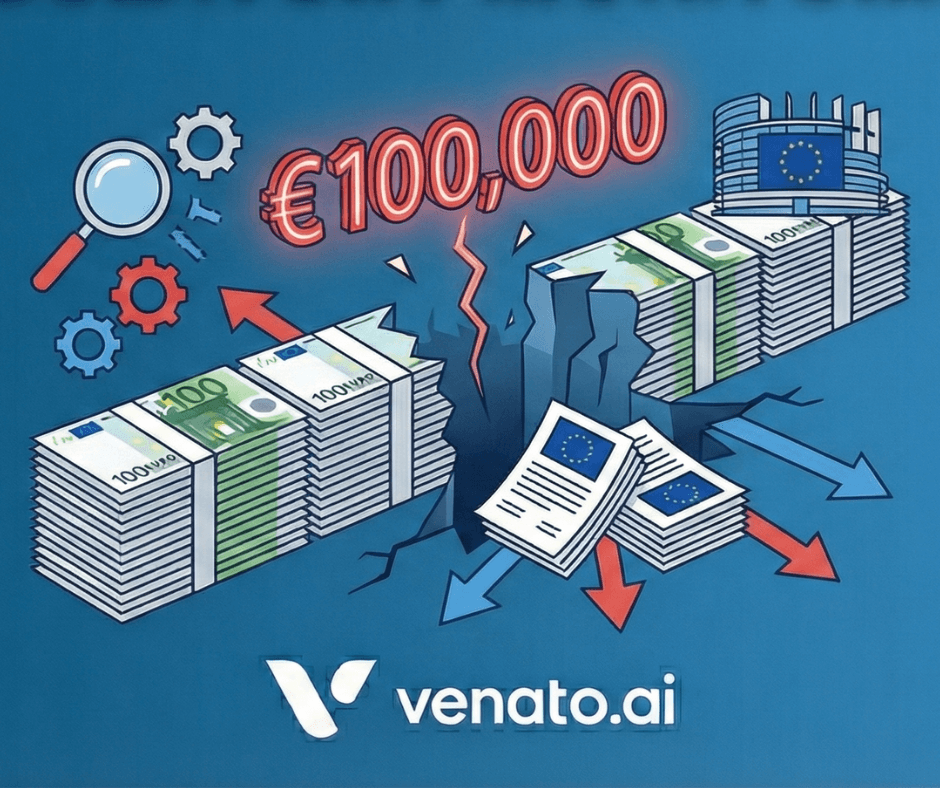
In Austria, a compliance firm can access any piece of legislation easily. Their data is easily accessible, understandable, and consolidated by the country’s gold-standard government legislation website. Compliance is easy, transparent, and affordable. This is not the standard elsewhere.
In Greece, that same compliance team is stopped dead in its tracks. Why? Because the officially recognized, consolidated version of the law is locked behind a commercial paywall, forcing a choice between a costly subscription, manual labor, or reliance on secondary, non-authoritative sources.
This contrast between an open-data platform vs systemic resistance is the definition of unequal data access in the Pan-EU. Despite the EU’s dream of a seamless single market spanning the continent, the reality is a maze of complex regulations, differing depending on the country and region you are in. This variation in access, moving from free, structured data to expensive, fragmented systems, hides enormous expenses, large amounts of wasted time, and an efficiency gap in Pan-EU regulatory monitoring. This inefficiency is a six-figure annual expenditure that only a smart, unifying AI platform can neutralize.
The Open Gold Standard: Learning from Austria’s RIS
If the goal is affordable, efficient, and accurate regulatory compliance across Europe, the model must be based on open data principles. No country exemplifies this ideal better than Austria with its Rechtsinformationssystem (RIS).
The RIS operates under a robust Open Government Data (OGD) framework, making it a gold standard for accessibility. Its excellence can be pinned down to three main features:
Open data: all the legislation can be freely accessed, used, and understood by anyone who needs it. This is exemplified by Austria, is the way that the data is not restricted, ensuring participation and allowing anyone to be able to understand and comply with legislation.
Consolidation: data that is not consolidated, compiled with all amendments since its publication, is not accurate and leads to extensive compliance issues. Austria’s legislation is officially consolidated, increasing efficiency by reducing the manual tracking of a piece of legislation, a rare trait for EU legislation.
Bulk download and machine-ready: a gold standard for open data is information that is available in a convenient and modifiable format, which is often machine-readable. On top of this, to make compliance efficient, Austria offers robust, bulk-download capabilities in the machine-readable format XML.
This efficiency is not a luxury; it is a direct mechanism for reducing regulatory friction. When companies can easily access and monitor changes to a country’s entire body of law, the barrier to tracking legal change lowers significantly. This, in turn, translates directly into lower compliance costs for the end-user.
Maximizing Open Data:
Venato AI is built to take full advantage of this "gold standard" infrastructure. For jurisdictions like Austria, Venato automatically ingests data from the open data portals in their preferred, machine-readable formats. This direct ingestion maximizes speed, accuracy, and completeness. By establishing a direct, efficient link to the official source, Venato ensures that its users receive updates not only in real-time but with the highest degree of confidence that the source is authoritative, removing the need for intermediary verification steps. Moreover, Venato centralises this legislation and provides the regulations that apply directly to your business/project, decreasing the overwhelming nature of regulatory compliance that is inherent even in gold standard legislative landscapes like Austria.
The Price of Protection: The Greek Paywall Focus
At the other end of the spectrum lie the jurisdictions that place consolidated legislation behind a commercial paywall, resulting in restricted data access. The lack of open data leads to the following data access plan:
Access the National Printing Office website for the Official Government Gazette: unconsolidated and therefore enormous.
Search for the specific law by its number and year to retrieve the original PDF: painstakingly slow.
For consolidated versions, identify and subscribe to a reputable commercial legal database in Greece: costly and risk of non-compliance due to a lack of official sources.
If a commercial database is not an option, prepare to undertake the manual process of consolidating the law by searching for all amending legislation in the Official Government Gazette.
This creates enormous hidden costs for firms, outlined below:
Direct subscription fees: The most obvious cost is the direct subscription fee for access to multiple, country-specific legal databases. A large multinational corporation or a law firm operating across a dozen EU markets may be forced to manage a corresponding number of vendor contracts, each with its own licensing structure, pricing model, and login credentials. These fees are a constant, unavoidable drag on operational budgets.
Legal Team and Wasted Expertise: The real inefficiency, however, lies in the human capital wasted on manual data retrieval and consolidation tasks. When a legal expert—whose annual cost (salary and overhead) can easily exceed £100,000—spends their day manually searching fragmented government portals, navigating multiple paywalls, or piecing together a consolidated law from separate gazette publications, that expenditure is a tax on time.
This manual effort is not just expensive; it is a major bottleneck that prevents strategic work. The cost of having highly-paid compliance staff tied up in non-strategic, manual data hygiene tasks is quantified in staggering industry figures:
Re-engineering legal and compliance processes to cope with new EU data flow restrictions can cost a multinational organization around €900,000 in additional annual costs for a team of 11 full-time equivalents (FTEs).
Overall compliance programs for major regulations (like the EU Taxonomy) cost companies an average of €500,000 annually just for reporting efforts and consultancy fees.
High-stakes regulatory efforts, such as GDPR compliance, demonstrate the sheer scale of the investment required, with many large companies reporting annual compliance costs of more than $1 million.
Non-primary source aggregators: To avoid these costs, some firms turn to cheaper, non-official data aggregators. This move introduces unacceptable legal risk. The official legal system is the only source that holds legal authority. Relying on a secondary source for regulatory text is a fundamental breach of due diligence, exposing the firm to fines and litigation based on potentially inaccurate or outdated information. The cost of risk far outweighs any perceived savings.
Neutralising the Data Gap: How Venato AI Unifies Access
The problem is the variability of the source data; the solution is consistency in data acquisition. Venato AI was engineered to normalize the disparate, fragmented landscape of EU national law into a single, company-applicable, and trustworthy data stream.
How Venato Centralizes Access:
Seamless Source Integration: Venato employs sophisticated, real-time web-scraping and API integration techniques designed to handle the idiosyncrasies of every jurisdiction. Where a bulk API exists (like in Austria), Venato uses it. For jurisdictions hidden behind paywalls, Venato leverages its enterprise-level access and technology to ingest the necessary texts and then standardizes them for the user.
Source Neutrality: For the Venato user, the underlying difficulty of the source disappears. Whether the data originated from a free, open-access portal or behind a commercial barrier, the user accesses the final, structured legal text in the same format, ensuring real-time detection and monitoring regardless of the source’s difficulty. The fragmentation is dissolved into one single, structured input, containing a timeline of a legislation’s amendments and how these apply to your business.
Structured, Citation-Based Output: Every single update, insight, and piece of legislative text provided by Venato is linked directly to its official source. This commitment to primary source data is essential for board-level reporting and provides the trust and reliability that generic AI tools often lack.
ROI Analysis: Exactly how Venato saves you time and money
Cost Factor Without Venato AI | Annual Estimated Cost | Cost Factor With Venato AI | Annual Estimated Savings |
Manual Retrieval/Consolidation | Up to £100,000 per dedicated expert full-time equivalent | Automated Ingestion | Full recovery of expert time for strategic tasks |
Multiple Vendor Subscriptions (e.g., Greek Law Paywalls) | Varies widely, often tens of thousands €/£ | Single Platform Access | Reduction of redundant subscription fees |
Legal/Consultancy Fees for Data Mapping | Average of €500,000 for major regulatory compliance | Unified, Structured Data Model | Significant reduction in external consultancy for data preparation |
Risk of Non-Compliance (Using Secondary Sources) | Multi-million-euro fines and litigation risk | Primary Source Assurance | Risk mitigation and guaranteed legal defensibility |
The true cost of compliance isn’t the regulation itself, but the lack of unified access to data. The discrepancies across European regions introduce high compliance risk and cost that is not feasible in the current regulatory climate.
Don’t let paywalls determine your risk exposure. Invest in a platform that guarantees comprehensive access, not just for the open data leaders, but for the restrictive markets too. Venato maximises the advantages of gold star legislative landscapes, as well as making compliance manageable and cost-efficient in regions lacking open data access.
In Austria, a compliance firm can access any piece of legislation easily. Their data is easily accessible, understandable, and consolidated by the country’s gold-standard government legislation website. Compliance is easy, transparent, and affordable. This is not the standard elsewhere.
In Greece, that same compliance team is stopped dead in its tracks. Why? Because the officially recognized, consolidated version of the law is locked behind a commercial paywall, forcing a choice between a costly subscription, manual labor, or reliance on secondary, non-authoritative sources.
This contrast between an open-data platform vs systemic resistance is the definition of unequal data access in the Pan-EU. Despite the EU’s dream of a seamless single market spanning the continent, the reality is a maze of complex regulations, differing depending on the country and region you are in. This variation in access, moving from free, structured data to expensive, fragmented systems, hides enormous expenses, large amounts of wasted time, and an efficiency gap in Pan-EU regulatory monitoring. This inefficiency is a six-figure annual expenditure that only a smart, unifying AI platform can neutralize.
The Open Gold Standard: Learning from Austria’s RIS
If the goal is affordable, efficient, and accurate regulatory compliance across Europe, the model must be based on open data principles. No country exemplifies this ideal better than Austria with its Rechtsinformationssystem (RIS).
The RIS operates under a robust Open Government Data (OGD) framework, making it a gold standard for accessibility. Its excellence can be pinned down to three main features:
Open data: all the legislation can be freely accessed, used, and understood by anyone who needs it. This is exemplified by Austria, is the way that the data is not restricted, ensuring participation and allowing anyone to be able to understand and comply with legislation.
Consolidation: data that is not consolidated, compiled with all amendments since its publication, is not accurate and leads to extensive compliance issues. Austria’s legislation is officially consolidated, increasing efficiency by reducing the manual tracking of a piece of legislation, a rare trait for EU legislation.
Bulk download and machine-ready: a gold standard for open data is information that is available in a convenient and modifiable format, which is often machine-readable. On top of this, to make compliance efficient, Austria offers robust, bulk-download capabilities in the machine-readable format XML.
This efficiency is not a luxury; it is a direct mechanism for reducing regulatory friction. When companies can easily access and monitor changes to a country’s entire body of law, the barrier to tracking legal change lowers significantly. This, in turn, translates directly into lower compliance costs for the end-user.
Maximizing Open Data:
Venato AI is built to take full advantage of this "gold standard" infrastructure. For jurisdictions like Austria, Venato automatically ingests data from the open data portals in their preferred, machine-readable formats. This direct ingestion maximizes speed, accuracy, and completeness. By establishing a direct, efficient link to the official source, Venato ensures that its users receive updates not only in real-time but with the highest degree of confidence that the source is authoritative, removing the need for intermediary verification steps. Moreover, Venato centralises this legislation and provides the regulations that apply directly to your business/project, decreasing the overwhelming nature of regulatory compliance that is inherent even in gold standard legislative landscapes like Austria.
The Price of Protection: The Greek Paywall Focus
At the other end of the spectrum lie the jurisdictions that place consolidated legislation behind a commercial paywall, resulting in restricted data access. The lack of open data leads to the following data access plan:
Access the National Printing Office website for the Official Government Gazette: unconsolidated and therefore enormous.
Search for the specific law by its number and year to retrieve the original PDF: painstakingly slow.
For consolidated versions, identify and subscribe to a reputable commercial legal database in Greece: costly and risk of non-compliance due to a lack of official sources.
If a commercial database is not an option, prepare to undertake the manual process of consolidating the law by searching for all amending legislation in the Official Government Gazette.
This creates enormous hidden costs for firms, outlined below:
Direct subscription fees: The most obvious cost is the direct subscription fee for access to multiple, country-specific legal databases. A large multinational corporation or a law firm operating across a dozen EU markets may be forced to manage a corresponding number of vendor contracts, each with its own licensing structure, pricing model, and login credentials. These fees are a constant, unavoidable drag on operational budgets.
Legal Team and Wasted Expertise: The real inefficiency, however, lies in the human capital wasted on manual data retrieval and consolidation tasks. When a legal expert—whose annual cost (salary and overhead) can easily exceed £100,000—spends their day manually searching fragmented government portals, navigating multiple paywalls, or piecing together a consolidated law from separate gazette publications, that expenditure is a tax on time.
This manual effort is not just expensive; it is a major bottleneck that prevents strategic work. The cost of having highly-paid compliance staff tied up in non-strategic, manual data hygiene tasks is quantified in staggering industry figures:
Re-engineering legal and compliance processes to cope with new EU data flow restrictions can cost a multinational organization around €900,000 in additional annual costs for a team of 11 full-time equivalents (FTEs).
Overall compliance programs for major regulations (like the EU Taxonomy) cost companies an average of €500,000 annually just for reporting efforts and consultancy fees.
High-stakes regulatory efforts, such as GDPR compliance, demonstrate the sheer scale of the investment required, with many large companies reporting annual compliance costs of more than $1 million.
Non-primary source aggregators: To avoid these costs, some firms turn to cheaper, non-official data aggregators. This move introduces unacceptable legal risk. The official legal system is the only source that holds legal authority. Relying on a secondary source for regulatory text is a fundamental breach of due diligence, exposing the firm to fines and litigation based on potentially inaccurate or outdated information. The cost of risk far outweighs any perceived savings.
Neutralising the Data Gap: How Venato AI Unifies Access
The problem is the variability of the source data; the solution is consistency in data acquisition. Venato AI was engineered to normalize the disparate, fragmented landscape of EU national law into a single, company-applicable, and trustworthy data stream.
How Venato Centralizes Access:
Seamless Source Integration: Venato employs sophisticated, real-time web-scraping and API integration techniques designed to handle the idiosyncrasies of every jurisdiction. Where a bulk API exists (like in Austria), Venato uses it. For jurisdictions hidden behind paywalls, Venato leverages its enterprise-level access and technology to ingest the necessary texts and then standardizes them for the user.
Source Neutrality: For the Venato user, the underlying difficulty of the source disappears. Whether the data originated from a free, open-access portal or behind a commercial barrier, the user accesses the final, structured legal text in the same format, ensuring real-time detection and monitoring regardless of the source’s difficulty. The fragmentation is dissolved into one single, structured input, containing a timeline of a legislation’s amendments and how these apply to your business.
Structured, Citation-Based Output: Every single update, insight, and piece of legislative text provided by Venato is linked directly to its official source. This commitment to primary source data is essential for board-level reporting and provides the trust and reliability that generic AI tools often lack.
ROI Analysis: Exactly how Venato saves you time and money
Cost Factor Without Venato AI | Annual Estimated Cost | Cost Factor With Venato AI | Annual Estimated Savings |
Manual Retrieval/Consolidation | Up to £100,000 per dedicated expert full-time equivalent | Automated Ingestion | Full recovery of expert time for strategic tasks |
Multiple Vendor Subscriptions (e.g., Greek Law Paywalls) | Varies widely, often tens of thousands €/£ | Single Platform Access | Reduction of redundant subscription fees |
Legal/Consultancy Fees for Data Mapping | Average of €500,000 for major regulatory compliance | Unified, Structured Data Model | Significant reduction in external consultancy for data preparation |
Risk of Non-Compliance (Using Secondary Sources) | Multi-million-euro fines and litigation risk | Primary Source Assurance | Risk mitigation and guaranteed legal defensibility |
The true cost of compliance isn’t the regulation itself, but the lack of unified access to data. The discrepancies across European regions introduce high compliance risk and cost that is not feasible in the current regulatory climate.
Don’t let paywalls determine your risk exposure. Invest in a platform that guarantees comprehensive access, not just for the open data leaders, but for the restrictive markets too. Venato maximises the advantages of gold star legislative landscapes, as well as making compliance manageable and cost-efficient in regions lacking open data access.
In Austria, a compliance firm can access any piece of legislation easily. Their data is easily accessible, understandable, and consolidated by the country’s gold-standard government legislation website. Compliance is easy, transparent, and affordable. This is not the standard elsewhere.
In Greece, that same compliance team is stopped dead in its tracks. Why? Because the officially recognized, consolidated version of the law is locked behind a commercial paywall, forcing a choice between a costly subscription, manual labor, or reliance on secondary, non-authoritative sources.
This contrast between an open-data platform vs systemic resistance is the definition of unequal data access in the Pan-EU. Despite the EU’s dream of a seamless single market spanning the continent, the reality is a maze of complex regulations, differing depending on the country and region you are in. This variation in access, moving from free, structured data to expensive, fragmented systems, hides enormous expenses, large amounts of wasted time, and an efficiency gap in Pan-EU regulatory monitoring. This inefficiency is a six-figure annual expenditure that only a smart, unifying AI platform can neutralize.
The Open Gold Standard: Learning from Austria’s RIS
If the goal is affordable, efficient, and accurate regulatory compliance across Europe, the model must be based on open data principles. No country exemplifies this ideal better than Austria with its Rechtsinformationssystem (RIS).
The RIS operates under a robust Open Government Data (OGD) framework, making it a gold standard for accessibility. Its excellence can be pinned down to three main features:
Open data: all the legislation can be freely accessed, used, and understood by anyone who needs it. This is exemplified by Austria, is the way that the data is not restricted, ensuring participation and allowing anyone to be able to understand and comply with legislation.
Consolidation: data that is not consolidated, compiled with all amendments since its publication, is not accurate and leads to extensive compliance issues. Austria’s legislation is officially consolidated, increasing efficiency by reducing the manual tracking of a piece of legislation, a rare trait for EU legislation.
Bulk download and machine-ready: a gold standard for open data is information that is available in a convenient and modifiable format, which is often machine-readable. On top of this, to make compliance efficient, Austria offers robust, bulk-download capabilities in the machine-readable format XML.
This efficiency is not a luxury; it is a direct mechanism for reducing regulatory friction. When companies can easily access and monitor changes to a country’s entire body of law, the barrier to tracking legal change lowers significantly. This, in turn, translates directly into lower compliance costs for the end-user.
Maximizing Open Data:
Venato AI is built to take full advantage of this "gold standard" infrastructure. For jurisdictions like Austria, Venato automatically ingests data from the open data portals in their preferred, machine-readable formats. This direct ingestion maximizes speed, accuracy, and completeness. By establishing a direct, efficient link to the official source, Venato ensures that its users receive updates not only in real-time but with the highest degree of confidence that the source is authoritative, removing the need for intermediary verification steps. Moreover, Venato centralises this legislation and provides the regulations that apply directly to your business/project, decreasing the overwhelming nature of regulatory compliance that is inherent even in gold standard legislative landscapes like Austria.
The Price of Protection: The Greek Paywall Focus
At the other end of the spectrum lie the jurisdictions that place consolidated legislation behind a commercial paywall, resulting in restricted data access. The lack of open data leads to the following data access plan:
Access the National Printing Office website for the Official Government Gazette: unconsolidated and therefore enormous.
Search for the specific law by its number and year to retrieve the original PDF: painstakingly slow.
For consolidated versions, identify and subscribe to a reputable commercial legal database in Greece: costly and risk of non-compliance due to a lack of official sources.
If a commercial database is not an option, prepare to undertake the manual process of consolidating the law by searching for all amending legislation in the Official Government Gazette.
This creates enormous hidden costs for firms, outlined below:
Direct subscription fees: The most obvious cost is the direct subscription fee for access to multiple, country-specific legal databases. A large multinational corporation or a law firm operating across a dozen EU markets may be forced to manage a corresponding number of vendor contracts, each with its own licensing structure, pricing model, and login credentials. These fees are a constant, unavoidable drag on operational budgets.
Legal Team and Wasted Expertise: The real inefficiency, however, lies in the human capital wasted on manual data retrieval and consolidation tasks. When a legal expert—whose annual cost (salary and overhead) can easily exceed £100,000—spends their day manually searching fragmented government portals, navigating multiple paywalls, or piecing together a consolidated law from separate gazette publications, that expenditure is a tax on time.
This manual effort is not just expensive; it is a major bottleneck that prevents strategic work. The cost of having highly-paid compliance staff tied up in non-strategic, manual data hygiene tasks is quantified in staggering industry figures:
Re-engineering legal and compliance processes to cope with new EU data flow restrictions can cost a multinational organization around €900,000 in additional annual costs for a team of 11 full-time equivalents (FTEs).
Overall compliance programs for major regulations (like the EU Taxonomy) cost companies an average of €500,000 annually just for reporting efforts and consultancy fees.
High-stakes regulatory efforts, such as GDPR compliance, demonstrate the sheer scale of the investment required, with many large companies reporting annual compliance costs of more than $1 million.
Non-primary source aggregators: To avoid these costs, some firms turn to cheaper, non-official data aggregators. This move introduces unacceptable legal risk. The official legal system is the only source that holds legal authority. Relying on a secondary source for regulatory text is a fundamental breach of due diligence, exposing the firm to fines and litigation based on potentially inaccurate or outdated information. The cost of risk far outweighs any perceived savings.
Neutralising the Data Gap: How Venato AI Unifies Access
The problem is the variability of the source data; the solution is consistency in data acquisition. Venato AI was engineered to normalize the disparate, fragmented landscape of EU national law into a single, company-applicable, and trustworthy data stream.
How Venato Centralizes Access:
Seamless Source Integration: Venato employs sophisticated, real-time web-scraping and API integration techniques designed to handle the idiosyncrasies of every jurisdiction. Where a bulk API exists (like in Austria), Venato uses it. For jurisdictions hidden behind paywalls, Venato leverages its enterprise-level access and technology to ingest the necessary texts and then standardizes them for the user.
Source Neutrality: For the Venato user, the underlying difficulty of the source disappears. Whether the data originated from a free, open-access portal or behind a commercial barrier, the user accesses the final, structured legal text in the same format, ensuring real-time detection and monitoring regardless of the source’s difficulty. The fragmentation is dissolved into one single, structured input, containing a timeline of a legislation’s amendments and how these apply to your business.
Structured, Citation-Based Output: Every single update, insight, and piece of legislative text provided by Venato is linked directly to its official source. This commitment to primary source data is essential for board-level reporting and provides the trust and reliability that generic AI tools often lack.
ROI Analysis: Exactly how Venato saves you time and money
Cost Factor Without Venato AI | Annual Estimated Cost | Cost Factor With Venato AI | Annual Estimated Savings |
Manual Retrieval/Consolidation | Up to £100,000 per dedicated expert full-time equivalent | Automated Ingestion | Full recovery of expert time for strategic tasks |
Multiple Vendor Subscriptions (e.g., Greek Law Paywalls) | Varies widely, often tens of thousands €/£ | Single Platform Access | Reduction of redundant subscription fees |
Legal/Consultancy Fees for Data Mapping | Average of €500,000 for major regulatory compliance | Unified, Structured Data Model | Significant reduction in external consultancy for data preparation |
Risk of Non-Compliance (Using Secondary Sources) | Multi-million-euro fines and litigation risk | Primary Source Assurance | Risk mitigation and guaranteed legal defensibility |
The true cost of compliance isn’t the regulation itself, but the lack of unified access to data. The discrepancies across European regions introduce high compliance risk and cost that is not feasible in the current regulatory climate.
Don’t let paywalls determine your risk exposure. Invest in a platform that guarantees comprehensive access, not just for the open data leaders, but for the restrictive markets too. Venato maximises the advantages of gold star legislative landscapes, as well as making compliance manageable and cost-efficient in regions lacking open data access.

Centralize & Simplify Regulatory Change Management
Centralize & Simplify Regulatory Change Management
Centralize & Simplify Regulatory Change Management